Showing posts with label Vectors. Show all posts

Vector Geometry

Vector Geometry

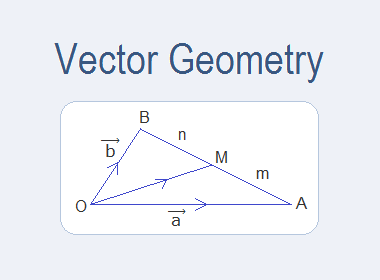
Vector Geometry: We can study different properties and relations relating to geometry with the help of vectors. Such a study is known as the Vector Geometry.


********************


10 Math Problems officially announces the release of Quick Math Solver and 10 Math Problems, Apps on Google Play Store for students around the world.


Install Quick Math Solver


********************


Install 10 Math Problems


********************


Here are 12 geometrical theorems and their proofs by vector method.

Product of Vectors

Product of Vectors

Product of Vectors: Product of vectors or multiplication of vectors can be performed in the following two ways:

-    Scalar Product or Dot Product

-    Vector Product or Cross Product


********************


10 Math Problems officially announces the release of Quick Math Solver and 10 Math Problems, Apps on Google Play Store for students around the world.


Install Quick Math Solver


********************


Install 10 Math Problems


********************


Vector Operations

Vector Operations

Vector Operations: The vectors can be added, subtracted or multiplied with one another. Addition of vectors, difference of vectors, multiplication of a vector by a scalar, product of vectors, etc. are called vector operations.

Types of Vectors

Types of Vectors

Types of Vectors: After we have learned ‘Vectors and its Components’ and ‘Magnitude and Direction of a Vector’, we’ll learn the Types of Vectors here. Vectors are of different types according to their magnitude, direction, and position with respect to another given vector, and by the method of representing vectors.


********************


10 Math Problems officially announces the release of Quick Math Solver and 10 Math Problems, Apps on Google Play Store for students around the world.


Install Quick Math Solver


********************


Install 10 Math Problems


********************


Following are the different types of vectors:


Magnitude and Direction of a Vector

Magnitude and Direction of a Vector

Magnitude of a Vector 

The magnitude of a vector is the length of its directed line segment from the initial point to the terminal point. So, the magnitude of a vector is a positive number which is the measure of the line segment representing that vector. The magnitude of a vector is also known as the modulus or absolute value of the vector.


********************


10 Math Problems officially announces the release of Quick Math Solver and 10 Math Problems, Apps on Google Play Store for students around the world.


Install Quick Math Solver


********************


Install 10 Math Problems


********************


Vectors and it's Components

Vectors and its Components

Vectors: Introduction


The quantities which can be measured are called physical quantities. Some physical quantities have magnitudes only but some physical quantities have magnitudes as well as directions.


********************


10 Math Problems officially announces the release of Quick Math Solver and 10 Math Problems, Apps on Google Play Store for students around the world.


Install Quick Math Solver


********************


Install 10 Math Problems


********************


Let us study the addition of some physical quantities. For example, if we have two rectangles of areas 6cm2 and 8cm2, the total areas of these two rectangles is (6 + 8)cm2 i.e. 14cm2.

Sum of areas of two rectangles of area 6cm2 and  8cm2 is equal to 14cm2.

If two forces 4N and 5N act on a body, what is the total force acting on the body, 9N or 1N? Its answer is uncertain unless their directions are known. If two forces have same direction the total force on the body is 4N + 5N = 9N.

Sum (or resultant force) of two forces 4N and 5N acting toward the same direction is 9N i.e. 4N + 5N = 9N.

If two forces have opposite direction the total force on the body is 5N – 4N = 1N.

Sum (or resultant force) of two forces 4N and 5N acting toward the opposite direction is 1N i.e. 5N + (-4N) = 1N.

In the calculation of some physical quantities, the direction has very important role.