Showing posts with label quadratic equation. Show all posts

Quadratic Formula

Quadratic Formula


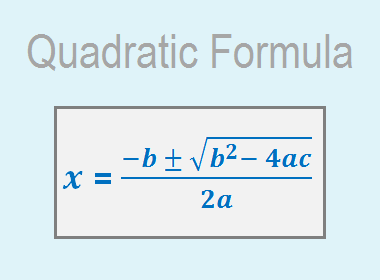
A formula to calculate the roots or solutions of a quadratic equation ax2 + bx + c = 0 is known as the Quadratic Formula which is given as,

"x"  = ("-b ± " √("b" ^"2"  "- 4ac" ))/"2a"

where a is the coefficient of x2, b is the coefficient of x and c is the constant term. We use this formula to find the required solutions (roots) of the given quadratic equation.

Some special conditions:

When b2 > 4ac, there are two distinct real roots.

When b2 = 4ac, there is a single real root.

When b2 < 4ac, there is no real roots.


********************


10 Math Problems officially announces the release of Quick Math Solver and 10 Math Problems, Apps on Google Play Store for students around the world.


Install Quick Math Solver

********************


Install 10 Math Problems


********************


Derivation of Quadratic Formula


Consider the general quadratic equation

ax2 + bx + c = 0, where a, b and c are constants and a≠ 0.

Rewriting the given equation as

ax2 + bx = – c

Dividing both sides by the coefficient of x2 i.e. a we get
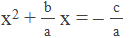
x2 + " b " /"a"   x = – " c " /"a"

In order to make the left-hand side a perfect square, we take half the coefficient of x,
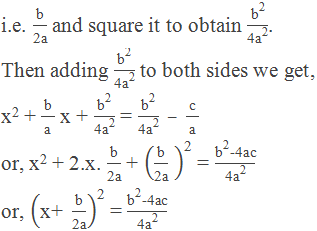
i.e. "b" /"2a"  and square it to obtain "b" ^"2" /〖"4a" 〗^"2"  .  Then adding "b" ^"2" /〖"4a" 〗^"2"   to both sides we get, x2 + " b " /"a"   x + "b" ^"2" /〖"4a" 〗^"2"   = "b" ^"2" /〖"4a" 〗^"2"    –  " c " /"a"  or, x2 + 2.x. "b" /"2a"   + ("b" /"2a"   )^"2"  = ("b" ^"2"  "-4ac" )/〖"4a" 〗^"2"    or, ("x+ "  "b" /"2a" )^"2"  = ("b" ^"2"  "-4ac" )/〖"4a" 〗^"2"

Taking square root to both sides, we get

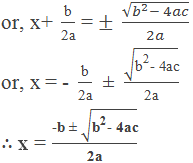
or, "x+ "  "b" /"2a"  = ±  √(b^2- 4ac)/2a    or, "x" = "- "  "b" /"2a"   "± "  √("b" ^"2"  "- 4ac" )/"2a"  ∴ "x"  = ("-b ± " √("b" ^"2"  "- 4ac" ))/"2a"

Hence the Quadratic Formula is derived.


Workout Examples


Example 1: Solve x2 – 7x + 12 = 0 by using quadratic formula.

Solution: Here,

x2 – 7x + 12 = 0

Comparing this equation with ax2 + bx + c = 0 we get,

a = 1

b = –7

c = 12

Now, by using quadratic formula,
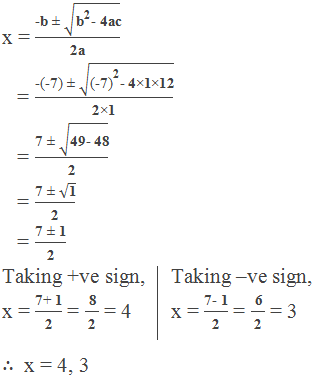
x = ("-b ± " √("b" ^"2"  "- 4ac" ))/"2a"     = ("-(-7) ± " √(〖"(-7)" 〗^"2"  "- 4×1×12" ))/"2×1"     = ("7 ± " √("49- 48" ))/"2"     = ("7 ± " √("1" ))/"2"     = "7 ± 1" /"2"  Taking +ve sign, x = "7+ 1" /"2"  = " 8 " /"2"  = 4 Taking –ve sign, x = "7- 1" /"2"  = " 6 " /"2"  = 3


Example 2: Solve (p – q)x2 + (p + q)x + 2q = 0 by using quadratic formula.

Solution: Here,

(p – q)x2 + (p + q)x + 2q = 0

Comparing this equation with ax2 + bx + c = 0 we get,

a = (p – q)

b = (p + q)

c = 2q

Using quadratic formula,
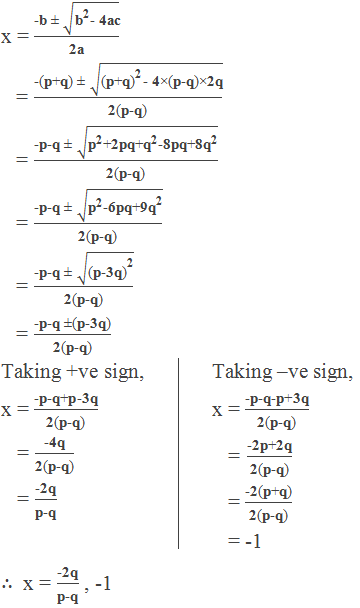
x = ("-b ± " √("b" ^"2"  "- 4ac" ))/"2a"     = ("-(p+q) ± " √(〖"(p+q)" 〗^"2"  "- 4×(p-q)×2q" ))/"2(p-q)"     = ("-p-q ± " √("p" ^"2"  "+2pq+" "q" ^"2"  "-8pq+8" "q" ^"2"  ))/"2(p-q)"     = ("-p-q ± " √("p" ^"2"  "-6pq+" 〖"9q" 〗^"2"  ))/"2(p-q)"     = ("-p-q ± " √(〖"(p-3q)" 〗^"2"  ))/"2(p-q)"     = "-p-q ±(p-3q)" /"2(p-q)"  Taking +ve sign, x = "-p-q+p-3q" /"2(p-q)"  = "-4q" /"2(p-q)"  = "-2q" /"p-q"  Taking –ve sign, x = "-p-q-p+3q" /"2(p-q)"   = "-2p+2q" /"2(p-q)"  = "-2(p+q)" /"2(p-q)"  = -1 ∴  x = "-2q" /"p-q"  , -1


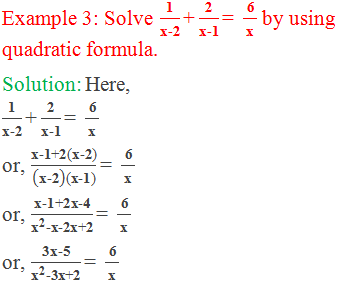
Example 3: Solve "1" /"x-2"  "+"  "2" /"x-1"  "= "  " 6 " /"x"  by using quadratic formula. Solution: Here, "1" /"x-2"  "+"  "2" /"x-1"  "= "  " 6 " /"x"   or, "x-1+2(x-2)" /("x-2" )"(x-1)"  "= "  " 6 " /"x"  or, "x-1+2x-4" /("x" ^"2"  "-x-2x+2" ) "= "  " 6 " /"x"  or, "3x-5" /("x" ^"2"  "-3x+2" ) "= "  " 6 " /"x"
 

or, 6x2-18x+12 = 3x2-5x

or, 6x2–18x+12–3x2+5x = 0

or, 3x2–13x+12= 0

Comparing this equation with ax2 + bx + c = 0 we get,

a = 3

b = –13

c = 12

Now, by using quadratic formula,
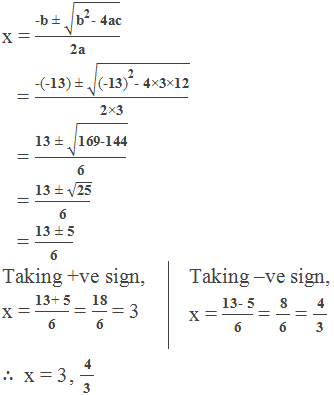
x = ("-b ± " √("b" ^"2"  "- 4ac" ))/"2a"     = ("-(-13) ± " √(〖"(-13)" 〗^"2"  "- 4×3×12" ))/"2×3"     = ("13 ± " √("169-144" ))/"6"     = ("13 ± " √("25" ))/"6"     = "13 ± 5" /"6"  Taking +ve sign, x = "13+ 5" /"6"  = "18" /"6"  = 3 Taking –ve sign, x = "13- 5" /"6"  = " 8 " /"6"  = " 4 " /"3"  ∴  x = 3, " 4 " /"3"


If you have any questions or problems regarding the Quadratic Formula, you can ask here, in the comment section below.


Was this article helpful? LIKE and SHARE with your friends…

Completing the Square Method

Completing the Square Method


In completing the square method for solving a quadratic equation of the form ax2 + bx + c = 0, we transpose the constant term c to the right-hand side of the equation, and then the left-hand side is expressed as a perfect square expression.


********************


10 Math Problems officially announces the release of Quick Math Solver and 10 Math Problems, Apps on Google Play Store for students around the world.


Install Quick Math Solver

********************


Install 10 Math Problems


********************


We use the following steps for solving quadratic equation of the form ax2 + bx + c = 0 by completing the square method:

Steps:

1.  Rewrite the equation so that the terms containing x2 and x (i.e. variable) are on the left side and the constant term is on the right side.
2.  If the coefficient of x2 is other than 1, then reduce the coefficient of x2 as 1 by dividing to both sides by the coefficient of x2.
3.  Add the square of half of the coefficient of x on both sides of the equation to make the left-hand side of the equation a complete square.
4.  Express the left hand side of the equation as a perfect square of a binomial.
5.  Use the square root property on both sides and calculate the roots.

This process of Completing the Square Method will be clear by the following worked-out examples.

Workout Examples

Example 1: Solve the following quadratic equations by completing the square method.
            a.    x2 – 2x – 8 =0
            b.    2x2 + 5x – 12 = 0
            c.     3x2 – 5x + 2 = 0

Solution:  a) Here,
                     x2 – 2x – 8 = 0
            or,     x2 – 2x = 8
            or,     x2 – 2x + 1 = 8 + 1  [adding both sides by 1]
            or,     (x – 1)2 = 9
            or,     x – 1 = ±√9
            or,     x – 1 = ±3
            or,     x = 1 ± 3
            Taking +ve sign,
                      x = 1 + 3 = 4
            Taking –ve sign,
                      x = 1 – 3 = –2
            ∴  x = 4, –2


Solution:  b) Here,
                     2x2 + 5x – 12 = 0
            or,     2x2 + 5x = 12
            or,     (2x2 + 5x)/2 = 12/2  [dividing both sides by 2]
            or,     x2 +5x/2 = 6
            or,     x2 + 2.x.5/4 + (5/4)2 = 6 + (5/4)2  [adding both sides by (5/4)2]
            or,     (x + 5/4)2 = 6 + 25/16
            or,     (x + 5/4)2 = 121/16
            or,     x + 5/4 = ±√(121/16)
            or,     x + 5/4 = ± 11/4
            or,     x = – 5/4 ± 11/4
            Taking +ve sign,
                      x = – 5/4 + 11/4 = (–5 + 11)/4 = 6/4 = 3/2
            Taking –ve sign,
                      x = – 5/4 – 11/4 = (–5 – 11)/4 = –16/4 = –4
            ∴  x = 3/2, –4


Solution:  c) Here,
                     3x2 – 5x + 2 = 0
            or,     3x2 – 5x = –2
            or,     (3x2 – 5x)/3 = –2/3  [dividing both sides by 3]
            or,     x2 –5x/3 = –2/3
            or,     x2 – 2.x.5/6 + (5/6)2 = –2/3 + (5/6)2  [adding both sides by (5/6)2]
            or,     (x – 5/6)2 = –2/3 + 25/36
            or,     (x – 5/6)2 = (–24 + 25)/36
            or,     x – 5/6 = ±√(1/36)
            or,     x – 5/6 = ± 1/6
            or,     x = 5/6 ± 1/6
            Taking +ve sign,
                      x = 5/6 + 1/6 = (5 + 1)/6 = 6/6 = 1
            Taking –ve sign,
                      x = 5/6 – 1/6 = (5 –1)/6 = 4/6 = 2/3
            ∴  x = 1, 2/3

If you have any questions regarding completing the square method, you can comment here in the comment section below.

Was this article helpful? LIKE and SHARE it with friends…